I found getting to look at the way that search engines work was really interesting considering I probably use one every single day but have never put very much thought in to it. I also think that the fact that my location and history can have an effect on what results I get from my searches is fascinating, if you are using that in a heritage context it could really help to narrow things down so you don’t get so many wide ranges of results that aren’t really relevant to what you are looking for. I also found the culture collage to be a particularly interesting part of this weeks activities and quite specifically the on this day part. I found it really cool to just be able to click on that and found hundreds of years of history from today alone, however, it did start to grow smaller the further back the years went, but that might be due to a lack of records rather than an inefficiency of the tool itself. Still a really cool idea that would make a fascinating project.
Month: August 2016
Week 2 – Reflections
Afternoon everyone,
Seeing the power of access in Trove Traces was great. Being able to see what the vast information available on trove is being used for, is great. Projects such as ‘knowthatproperty.com’ wouldn’t have existed if it wasn’t for the incredible accessibility that trove offers. But with accessibility, comes some downsides, for the content made trove data is as good or bad as the user intends. I think the freedom to use the data how you wish is important, it is just a shame there’s a minority of people using it in hateful ways.
Zooniverse was really interesting! I was intrigued by many of the crowdsourcing projects; it was hard to choose one to try out. I ended up going Science Gossip. Science Gossip is dedicated to annotating images found in scientific journals of the Victorian era. I found the process really simple and easy to do, while also intriguing. I’ve thought about what makes me compelled to put more time into a crowdsourcing project like Science Gossip, and personally I think I’ve got three main reasons for doing so. First is that I find it fun! Science gossip gave me a few intriguing images to annotate, and the curiosity of what the next image could be made me want to keep going. Second is the idea that I’m helping such a huge project, the idea that a small amount of effort on my part, combined with the effort of the ‘crowd’, can do something bigger than any project team could manage on their own is fantastic! Thirdly, the ease and accessibility of the website makes it compelling, it’s incredibly easy to be a part of it. I hope others found it compelling enough to try again, I know it has been for me.
As a 20-something, I’d like to think I’m fairly proficient when it comes to social media. That said, Twitter was the only major social media I didn’t have an account on. Not anymore. I quite enjoyed the twitter bots we looked at, particularly the New York Public Library Emoji Bot. Simple fun, while encouraging engagement with collections, what’s not to love.
Ok, that’s it from me, lets see how week 3 is.
Cheers,
Aiden
Week 2 Reflection
The week 2 workshop continued to unpack, for me, the terrain of the digital world and how it can be harnessed in various ways to signify, signpost, highlight and interact with our cultural heritage.
Afew of the central thematic and conceptual tenets of our workshop and discussions include how history can be wielded by everyday people in digital heritage, primarily motivated by their specific interests and passions, allowing for other enthusiasts to explore, learn and fathom the depths and outposts of their chosen interest. In the digital terrain, ethical and critical thinking issues naturally come to the fore, due to newness and novelty inherent in this forum. I really liked the Zooniverse platform and how crowd sourcing initiatives can be instigated to propagate and build heritage archiving projects.
Oh,and I got over my reservations with Twitter – I signed up and have since really enjoyed seeing how bots work to highlight concepts and conversations in the general domain and how these can be creatively exploited and highlighted.
The possibilities for a project are expanding exponentially, however, I want to focus on and decide on an personal area of interest, over the next week, before I can explore my options for enacting this project.
Week 2 Reflection_Yizhuo Zhang u3125186
Week 2’s class is a great experience, I want to talk about crowed sourcing first.
I’ve got lots of fun on crowed sourcing, I have helped recognize handwriting words or words printed, draw a frame on animals’ faces, recognize plants and contribute info.
However, I’ve got a question about crowed sourcing website like Zooniverse, if someone contribute wrong information, how does it will be corrected? Or, if a person or a group of people deliberately contribute wrong information, how to avoid that? Maybe the system will select a “average” answer to one item, but if most of them are wrong, how to do it?
So I think the best solution is Webmaster or experts read them, and revise it.
Or maybe like the Wikipedia, everyone can see other people’s change, and revise them.
So I think crowed sourcing is a good method for digital heritage reservation, but it still need to be improved. And the most accurate way is do these things by experts or person who reliable.
The bots on Twitter are very interesting as well. I have heard bots on Twitter before, and also on China’s edition Twitter Weibo. It’s very conviniente for people to find what they want to know, and also very important for digital heritage research.
But, something I’m concerning as well, that is, people may teach bots bad things. ie, Microsoft has launched a bot on Twitter several months ago, but people find it start to reply bad words, then, Microsoft found the reason is many people tell bad words to the bot, and the bot learnt them.
So I think it’s one of the point we need to be careful in bots for digital heritage research.
Week 2 Reflection
The content of week two was really fascinating as it really demonstrated to me how you can use these tools to make heritage or museums interactive and fun and use that to benefit the cultural community as well. To me the element of the lesson which stood out the most was getting to visit the zooniverse website and gain a glimpse of how the public can interact with the crowdsourced products on the website. This website I have definitely found extremely useful in starting to think up an idea for my project proposal the use people to count out the amount of penguins in images or to identify what type of animal is located in an image take in the Serengeti gave me a lot of inspiration and I think it could be targeted really well towards museums and their daily intake of visitors, this is still a developing idea though.
Week 2 Reflection
Week 2 Reflection
The following are my thoughts on several things covered this week.
I found Trove Traces very interesting. While not all that surprising, the thought of being able to see what all the information was being used for opened up interesting questions. This also creates possibilities to determine and then better provide the kind of information that the public finds useful.
I am very interested in the applications of crowdsourcing, Zooniverse and its use of crowdsourcing made many seem like interactive games yet they are productive. I don’t have any clear idea yet, but I am thinking of possibilities in this style for my project.
The use of bots for heritage was sort of interesting since I already knew the standard applications of bots I at first thought “well it retrieves a random link, its cool, but what is the point?”. After thinking on it for a while I could see the potential, especially with the @everythreeminutes bot. This bot I found incredibly powerful, bringing information like this into everyday life and the digital sphere in such a connective way is a genius move. I hope we see more similar and interesting uses for bots in the future, I am sure we will.
James.
Introduction
Hello!
I’m Nour, I’m currently in my third year of Museums, Heritage and Conservation, majoring in Conservation and with a particular interest in painting conservation. I currently live on campus at Cooper Lodge, I work at Coles Belconnen (hi if you’ve seen me there!), and volunteer at the Calvary hospital, between work, volunteering and uni I try to stay active/busy by riding around the lake, painting, and reading. I wish I could say I do these things every day but realistically I can be pretty lazy most of the time.
I moved down from Melbourne just under three years ago to study at UC. In Melbourne I started and stopped a number of different courses trying to find something I was really passionate about; I tried to study visual arts but it wasn’t enough for me, then I tried to study science but it was too much for me – hidden somewhere between visual arts and science was painting conservation and it turned out to be a career I was passionate about pursuing! I’m half Syrian and half Lebanese so the dream is to one day work as a conservator in the middle east (keyword: dream).
I am really interested in heritage, but before starting this course I never considered the idea of digital heritage, but since touching on this topic in my past semesters I have found it to be not just interesting, but really important. I will be completing this unit primarily as an online unit due to a clash between this and Forensic Science but I am really excited to see how the semester progresses.
That’s all from me – but I’ll leave you all with this picture of me at the Jurassic World exhibition at the Melbourne Museum a few months ago.

Seeya 🙂
Introducing you to Lucy ?
Hello there,
I’m Lucy and I’m studying the Bachelor of Museums, Conservation and Heritage at the UC, with a particular interest in the Heritage and Museum majors. I’m an original Canberra girl and currently work as a receptionist. I’ve just finished my Interior Design certificate as well so love surrounding myself with all types of pretty things! I’ve also worked as a feature writer for a Canberra based arts publication Big Ink and have done some volunteering for CMAG.
I was primarily drawn to the degree as I love telling stories, finding new stories, and sharing them around – I originally wanted to be a writer! However I think that this is really what history is about, and finding stories that have been unheard of and making it accessible to anyone is really powerful and I think an amazing job (and purpose) to have. So I had a change of heart and leapt into heritage studies and never looked back. I’m super excited for this unit and can’t wait to learn how I can be more active in some of the really cool changes that are happening in how we engage with, examine and share our history through the new technologies of our own history. Having already completed the Museum and Collection Managment unit in 2015, also run by Tim, I have a feel for a couple of the things we might be doing but know I have a lot to go :0
Apart from studying you can find me at the gym, going on adventures with my partner, or feeding my addiction; movies. My Dad works at the National Film and Sound Archive so my love of stories, movies, history and museums runs in the family!
Here I am at my most recent museum visit, The Dinosaur Museum 🙂 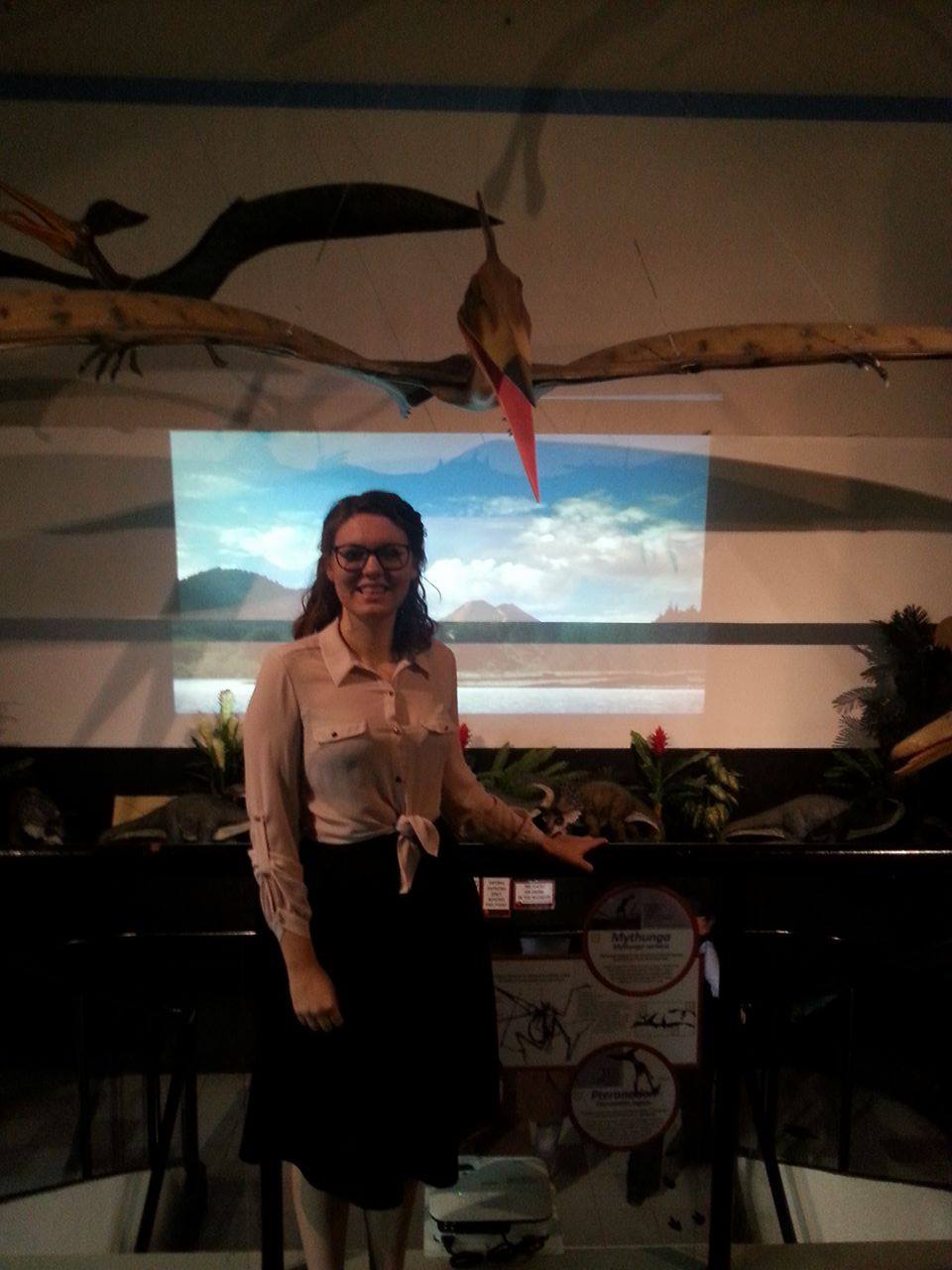
Introducing Me
Good Evening,
My name is May Colville, I am currently enrolled in the Bachelor of Heritage, Museum and Conservation. I have a background in Archaeology from ANU and UNE. I have also undertaken a couple of volunteer projects under the auspices of the University of Sydney and the American Archaeological Center.
Outside of my schooling, I am a Canberra girl who loves to travel, I just got back from a year in Canada and am already dreaming about my next trip. Also I am a huge nerd, love sci-fi shows and movies and am always up for a good (or not) fantasy novel.
I am taking this unit as it is required, although the use of the internet for history has never really interested me, the use of new technologies and new application of old technologies has. For example LiDAR and Geospatial Imaging for mapping and identifying archaeological sites has always interested me.
Anyway, I hope that gives you a good idea of who I am as a person and I look forward to interacting with you all as the unit and degree unfolds.
Best Wishes,
May Colville
PS I am a sucker for a good pun.
Introducing Anna @ Exploring Digital Heritage
Hello !
I’m a student participating in the bachelor of heritage, museums and conservation program at uc. I begrudgingly enrolled in this unit – little confidence in using computational tools and barely turned on by digital interfaces – however, Tim’s work and facilitation has enthralled me and I’m looking forward to proposing a project based on my interests: our world, the landscape, humanity, ideas, art, culture, conscience, instinct, identity, crafting, collecting…..
My background is in making (functional) ceramics & art education, I mostly work in an art gallery, with conservators, curators, archivists, librarians registrars and installers, I like going for walks, cycling and seeing films and practicing yoga.
Wishing you all well.
