Week 12 Reflection

I found the information presented in ‘Unremembering the forgotten’ Very interesting the fact with just a few lines of code the gender ratio of the scientists involved could be found shows just how easy it can be to find interesting things. The nature of the talk and how it addresses the unpopular side of Australian history, stories that are outside discourse and what digital heritage can possibly do for this kind of history, I found particular interesting the fact that access can never simply be given and that it must be taken to a certain extent. There is much to find on the surface but there is much more beneath, a sort of web based archaeology I guess, it really is exciting. It really can lead to all sorts of things bubbling forth, challenging, intriguing and creepy things, I agree that it really has a potential to make a difference.

For example 80-90percent of the population of the Americas died from smallpox or other factors of european settlement. This figure is absolutely horrific but it does not connect with people. As you have stated faces really do something to people they prompt such a large amount of emotion, therefore it would be interesting and confronting to bring a face to the estimated  2-100 million native americans that died. Perhaps faces that are in turn made of faces and those faces are composed of faces etc, like those montages that create a face out of other images except it just goes deeper and deeper. There are many possibilites perhaps using maps, graphs or other forms of data visualisation.

It really does make you think of the power that digital tools have to make a difference to the way we see each other, the past and ourselves.
Week Eleven – Archiving the Web ?

This week we looked at archiving tools available to use to archive collections, but a lot of these tools could be used to archive other things around the web.

The most useful tool I found was Wayback Machine, a site that allows you to access a bookmarked page as it was the time it was saved. I can see this being a really useful took for my journalism units as often I want to save the top stories for the day if something significant has happened, or view articles before further changes are made they have been updated or edited. Carrying on with journalism and media, this tool would be fantastic to capture news sites stories with impact and significance such as an election or an Olympic triumph. This would be the modern day equivalent to saving the front page of a newspaper for archival purposes, creating a snapshot of a moment.

Jacinta?

Week Ten – VR, AR, and Games ?

Hi everyone,

This week we looked at digital heritage through the realm of virtual reality (VR), augmented reality (AR, a 3DS can do this!), and 3d.

There is so much possibility for digital heritage here! I was especially impressed by Street Museum, an app that brings up historical images based on your location. It would be fantastic to see this expand to other locations, and even have people contribute their own images, like a fusion between Raidiooooo and Google Maps.

Speaking of Google, we also looked at Google Arts and Culture’s virtual tour of the National Museum of Australia. I’m already quite familiar with the virtual tours, having used them in the past to ward away boredom and to admire museums from afar (the Museum of Islamic Art in Qatar looks a lot like the Art Gallery of Western Australia, or at least the atrium does.) I really hope that more cultural sites and institutions are added, and that new and exciting ways of virtually accessing cultural material becomes available.

Until next time

Jacinta?

Week Seven – Adventures in Time and Space ?

I really love everything about maps. Well, physical maps at least.

It was strange looking into all the different mapping tools after taking Cultural Heritage Field School last semester and using ArcGIS.

The highlight of this lesson was georectifying the map of 1865 Melbourne. I wonder whether you could pop these over Google maps for an authentic self-guided tour of a city? Plus, add on the information from Know That Property and you’ve got yourself an exciting tour!

Jacinta?

Week Four – Big Data ◼️ Small Data ▪️

Hey everyone,

This week was all about data. Focusing on Australian data sources, it was interesting to see the types of data that is available to use for digital heritage projects.

One of the data sources is the Australian Data Archive who hosts digital records of census data from 1833 to 1901. Though I didn’t make a graph with the data on Plot.ly, a graph making site that I didn’t want to sign up for, I am aware of the benefits of presenting information in a graph. Graphs are an easy and accessible way to quickly present information and identify trends.

Other sources of data can come form state and federal sites such as data.gov.au and data.act.gov.au however I found that these sites require some digging for heritage related content and when I finally found content it was in a weird format. Luckily WTFcsv was available to use. WTFcsv is a site that breaks down the content of a cvs file graphs it for you! If only there were more sites like plot.ly and WTFcsv.

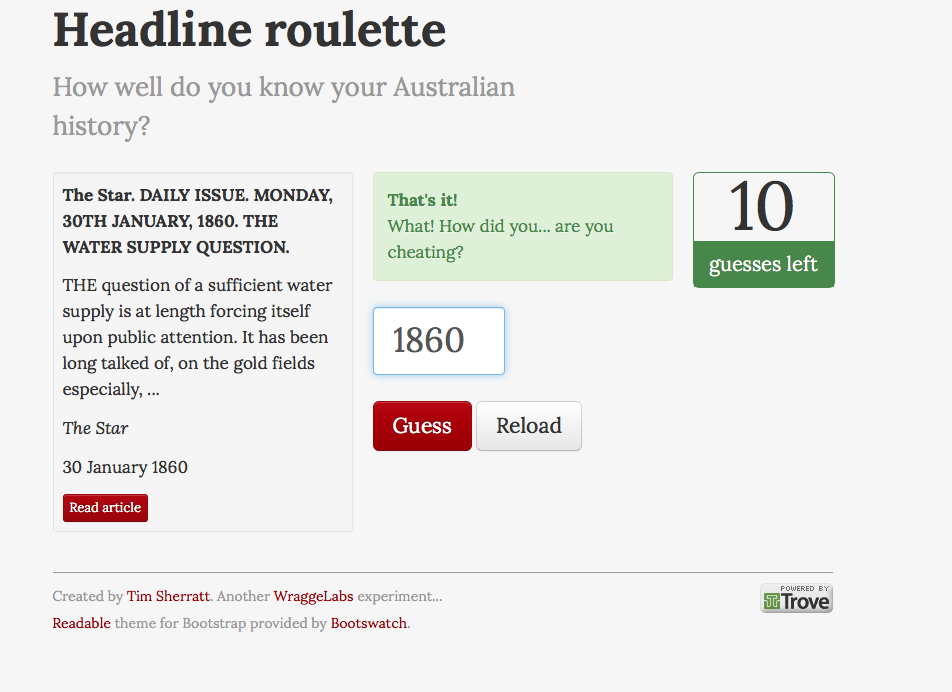
I didn’t quite understand the API and data scraping concepts however the highlight of the lesson was playing around on Headline Roulette as it was fun and engaging. A few times the site did give me the answer, usually within the headline or first few pars (sentence in journo language). Sorry, Tim.

screen-shot-2016-10-27-at-1-16-31-pm

Jacinta?

Week Three – Collections and Contexts ?

Hi everyone,

Tim was in the Netherlands ?? this week so we were left to complete this week’s activities at home.

Starting off with an exercise in Google search we were asked to look up images of professional hairstyles and unprofessional hairstyles. I was really surprised when there were no Mohawks in sight for the unprofessional styles; instead the results were of natural African hair. Looking at professional hairstyles the results were starkly different, almost all white women! Though apparently Google’s search algorithm was ‘mirroring conversations about “unprofessional hair”’ I felt as if Google could have done more to avoid controversy and reputational risk though variation of its search results more (where were the Mohawks?!)

This exercise flowed into the topic of bias and selection for digital cultural material. I found a lot of the material difficult to follow without guidance. But the idea I got from it was that there is a lot of content that gets buried in search engines like Google and Trove, and the issues surrounding how we curate our online content like culturally sensitive or copyrighted materials.

css.php