Reflection – Week 9

In todays class I learnt how to zip up a file on a mac. So unlike PC’s, mac automatically unzip your files. Which doesn’t help when trying to carry out tutorial tasks. It’s not hard but whenever I hit roadblocks and things don’t work perfectly as detailed in the steps I stop, instead of pushing through to find the answer straight away. Anyway I found the answer in record Amanda time today and can now move on with the rest of the task. So I tried the Reduction task with interesting results. After uploading the zipped files and waiting well over the suggested 3-4 minutes training time, I was able to see how the recognition program works.


Every week we are shown something new that I would love to implement on some kind of cultural heritage endeavour. If seems fairly simple using the visual recognition program and I wonder if it could be used to identify family heirlooms or museum acquisitions. You know how people take their treasured possessions to some expert on ‘Antique Road Show’ or a local expert. What about a program that people could use to identify their object at home. I guess the database would need to include millions of images and information collaborated by many experts. But it could be possible. This type of program would be particularly useful for classifying museum acquisitions especially in smaller museums where an expert may not be present. Once the object has been identified it could be presented with a list of history, display, and care instructions. 3D imaging would also help the accuracy of the recognition program.


As for recognition use in the future with all its dangers and issues, humans have always recorded the past. And like the use of redactions, decided for whatever reason to include or not include parts of those details in their retelling of their version of the past. We, as a human race have managed to mold our past as accurately as our memories and personal requests have desired. So, yes using technologies might also skew the history records, but that really is no different to what has previously been happening. So I think the danger here is not so much in the false positives a machine gives but the power we are giving to machines in writing our past.


This isn’t all doom and gloom though whatever the out come the human race will still move forward and deal with whatever catastrophe we create by our own doing and it will be just another story for the history book. If technology is going to keep growing in use and advances as it has (and of course it will) then people just need to soften up to the fact that yes they may one day be labelled a gorilla like Google’s photo app mishap, or Asian when frowning (as in one of Tim’s facial recognition examples) or any other number of titles. Besides I don’t think the new fashion styles for avoiding facial recognition are that bad. They are very futuristic and the future is where we are all heading.
Week 11

Ok this is unfair, I’m trying to get these responses done quickly, but then there iss a link to classic arcade games, and solitaire?! I’m not getting that hour back.

Jokes aside, functional archiving of digital material is fantastic, it really leans into the idea that heritage is best when holistic experiences are preserved, not just the evidence of them. For tangible heritage its a lot harder, keeping functional items functional, and able to be used by anyone, is often difficult or impossible. For example, keeping a 100 year old motorbike working, and letting anyone who asked a ride of that bike would not only be dangerous, but probably damage the bike itself. But anyone can play Sega’s Hang On.

Again, saving old websites, and UI’s and games, seems closely linked to ideas of intangible heritage. I mean, they’re pretty much intangible anyway being digital, but being able to preserve the experience of using Windows 3.1 is amazing, particularly when we live in a world of constant updates to software.

Week 10 Reflection

Hi all,

First off, who wants some honey? Making a 3D object with just your phone is great! Last week some items at work were being 3D scanned with a device and custom software costing a small fortune! Albeit, their model is significantly higher quality.

I’d like to talk about what happened at work with the 3D scanning for just a bit. The in house Multimedia team scanned an item for display, to then 3D print a custom mount. Pretty cool stuff I thought. I’ve also been a part of a conservation project, where we needed a 1:1 replica made of a small model of a first world war soldier, so we got one 3D scanned and printed. The newly printed 15cm tall model is on top of a Diorama in the First World War Gallery at the Australian War Memorial, in amongst models that were made 20 years ago, and you can’t tell the difference between them. Although, if you have a sharp eye you can see that two of the figures are holding the exact same pose. Little easter egg to look for if you’re ever wandering the gallery.

My point here, is that I’ve had multiple interactions where 3d scanning, and printing, and it has been a practical solution to common museum exhibition problems. So I don’t think 3d scanning and printing is gimmicky, although I am aware that there are solutions to those problems without the technology. Exhibition mounts and replica’s can be made without 3D scanning/printing, its just more convenient, and accurate than traditional solutions, and 3d scanning is getting cheaper (see my honey model above which I made for for free).

3D Tours on the other hand, I’m not sure I’m sold on.

I like the idea of them, creating a 1:1 digital representation of a space is pretty cool, particularly when it is somewhere very hard to get to, like somewhere far away, or impossible to get to, like somewhere that no longer exists. But what always falls short for me is viewing a 3d space, on a 2d screen, just isn’t particularly immersive or interesting. Don’t get me wrong, it’s not that I think it isn’t possible for 3D spaces to be immersive or interesting, much the opposite; I’ve spent countless hours playing video-games because of their immersion. I understand that a fictional world is probably easier to make interesting than having to be confined to copying reality, but I don’t think i’ve ever seen a virtual tour of a site or museum that has come anywhere close to making me want to just explore.

Although, if I had minecraft downloaded on this computer I’d definitely be checking out the Gallipoli map made by Auckland museum. Seem like a great project.

I’m not sure about Heritage VR just yet. Not becauce I’m particularly skeptical, I just haven’t tried it yet. I’ve tried some VR, but nothing remotely related to heritage, but I can think there are some cool projects that are possible with the technology. As far as whether or not Heritage VR is a gimmick, I’m not sure, we’ll have to see after the tech is more accessible.

Anyway thats it for me.
Cya next time.

Week 10: Virtual Realities

I love the potential for 3D imaging (and printing) and am so glad it has been discussed in this class because not only is it weirdly cool and futuristic, it has so much use in the heritage field. I actually really like th example of when a historicaly significant arch had been destroyed in Palmyra by Islamic state, 3d imaging from UNESCO was used by the Institute of Digital Archaelogy to create a 3D print of the arch using Egyptian marble and now stands in Trafalgar Square. Not only is this letting a new audience interact with something that may not have otherwise (also good like Tim suggested from educational purposes for remote towns but also good for potentially dangerous countries that have a wealth of historical objects many can’t access) it’s also saving that object as well. Touching and seeing an objects physicality is a primary component of engaging with, understanding and enjoying an objects, and gains context to its history. Recently I visited the 100 objects of the world at the National Museum, and one of the objects is the original wood cut of Durer’s Rhinoceros. Next to the originial the National Museum has a hologram of the rhinoceros and a link to a 3D printable from their website. These are there to represent the inaccuracies in the drawing (as it is considered a non-accurate drawing of a rhinoceros that was taken as fact by the British) as well as a good educational tool.

I do agree that we don’t want to get too caught up in augmented or virtual realities, as it takes away the realness of seeing objects (we’ve all seen the Mona Lisa before, but how many have really seen it is different.) However I think that in terms of accessibility it is a great digital strength, those who may not have money, physical ability, or live too far away can experience museums that they may have interest in personally or academically. In regards to specific museum’s purposes this may match many criteria of letting the public experience history and sharing that.

Here is an example of my own 3D image using 123d catch, I have a humble collection of Buddhas so here is on

Week 11: Archiving the web

This is something that really has not occured to me before but really should have. Archiving the web has so many purposes, and offers such a great insight into the technology, opinions and social practises in contemporary history. In particular WebRecorder is an interesting tool for personal curating of your own experience with the web, and takes control of both literal history and the way we engage with it. No non-digital tool could simultaneously use the technology it is trying to archive and show its capacity. Storify is an example of collecting reactions/thoughts that I think has a lot of potential. Obviously twitter already has the ‘search’ tags, which similarly does what Storify does, but Storify allows you to curate, and present it in a tangible and analytical way. I made my own on the reactions of twitter promoting the Smithsonian’s kickstarter project to help raise funds to preserve Dorothy’s ruby slippers from the Wizard of OZ:

I always think in terms of collecting and objects, what can this tell people 100 years from now and does it matter? In this time the internet would be a hugely significant thing in communicating to people from the future studying history of today of what society was like. I think capturing not only websites and their history, but it’s also a new way of capturing people’s beliefs and opinions on social media which is really cool.

Week 7 Reflection

Hey everyone, I’m catching up on some of the lessons I’ve missed over the semester (no better time to do it than when I can use the free wifi at uni!).

The topic of maps accurately depicting reality reminds me of something I read recently about American students not realising that the world map looks like this in every other country because the maps that are used in American schools look like this (Chopping Asia in half so that America can be in the middle!).

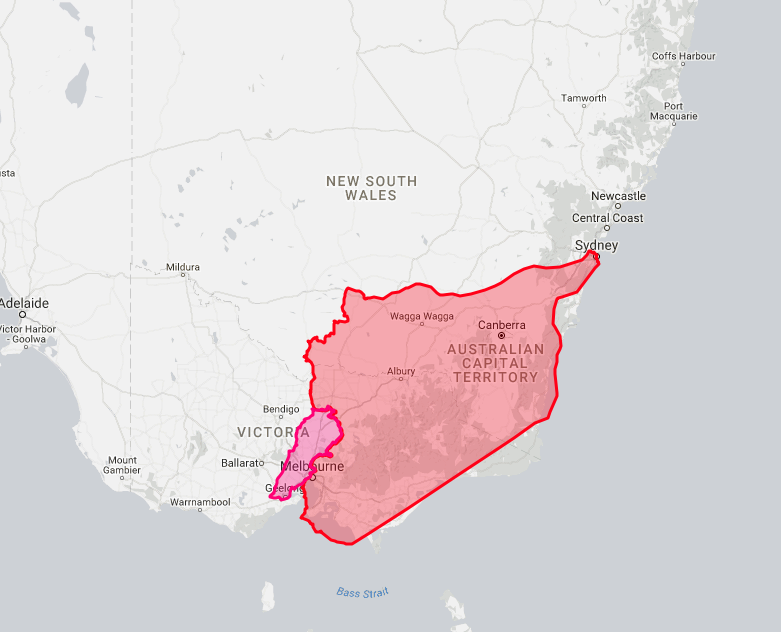
I had a bit of fun with http://thetruesize.com and used it to compare where my parents are from (Syria and Lebanon) to where they currently live (Melbourne, Australia).screen-shot-2016-10-19-at-2-42-17-pm(Syria is red and Lebanon is pink)

The True Size is a really cool programme but I wish it allowed users to map states in Australia, or islands. Specifically so I could see the size difference between Canberra and some islands that I want to visit, or live in. Whichever I can afford first.

I also created my own map in Google maps; I started off in Syria and Lebanon again and then mapped out where all my immediate family are around the world.

I thought the idea of georectifying Australian maps was intriguing but I couldn’t really get it right (despite the steps being written out for me!).

This lesson was mostly* enjoyable because it got me thinking about things I previously haven’t given much thought to, and it brought up the story of the random Kansas farm which was unusual and different. The lesson gave me a better understanding of maps, and how complex they are.

*mostly enjoyable but frustrating when I couldn’t get certain things to work for me.

Thanks,

Nour 🙂

Week 9 Reflections

Good Evening

Running late again, so here we go.

Both the redaction art, and the face finding, made me think of other ways in which clever scripts can glean information from databases. Could programs search collections to help identify items? The idea being that the image of the item is being used to supply information, rather than curatorial data or tags. I’m thinking of physical collections rather than archives, however, I doubt that would be necessary, as most items photographed for collections should have descriptive information attached prior to photography right? I wonder what collections WOULD find that useful. I guess that would make it a form of datamining, where the program is looking for images/shapes rather than text. I think it would be useful in some of the crowdsourcing projects we saw earlier in the semester on Zooniverse.

I work at the Australian War Memorial, where there is a running project to find portraits of all the first world war service personnel. I wonder if the collection has been searched with facial recognition software? Perhaps something to ask the curators tomorrow.

Also, here is my tweet for the Vintage Face Depot. Hmmmm

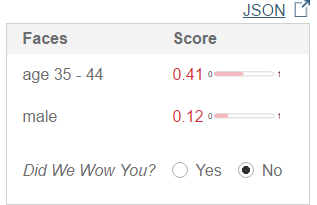
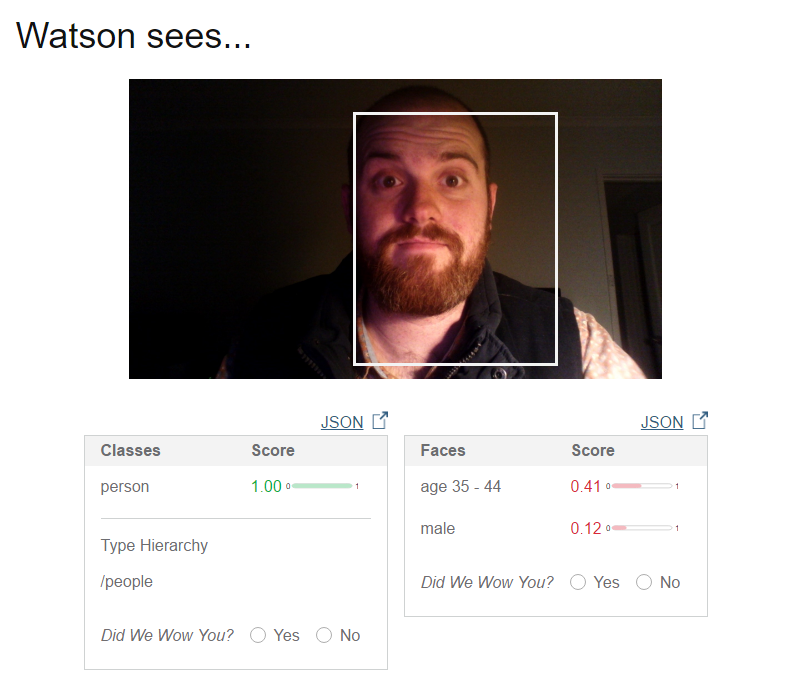
I just tried out the IBM demo system, and it’s pretty cool! Here is what it had to say about the same photo I used for Trove

watsonthinksofmePretty good, but I’m not particularly wow’d by how old Watson thinks I am.

watsonthinksofmeno

What sort of half-rate super computer can be thrown off by twelve years by just a little pre-mature balding?

Anyway, I couldn’t get the demo to work on the redaction data, I’ll have to try again later.

Goodnight all!


Week 10 Reflection

Hey everyone,
Last lesson we looked at the interaction we have with space, through 3d digital imaging, virtual tours and such.

The topic of virtual tours was interesting because it brought up a lot of different opinions. We clicked through the National Museum of Australia’s virtual tour and not everyone liked it because it isn’t the best representaton of reality. I however really enjoyed the idea of virtual tours because, the NMA for example, is now more accessible to people with disabilities.

We also looked at museums and galleries around the world created 3D images and models of objects. I think this is great for SO many reasons. Some people in class said that having a 3D image would make researching a particular object easier than trying to work with a 2D image, whilst others stated that having that documentation is important in case of a disaster that leads to the destruction of an original object. At the AICCM conference in Hobart last year I remember one of the talks being about how museums and galleries have started using 3D replicas of objects for different reasons. One talk was about integrating 3D replicas into tours for visually impaired visitors to allow them to experience the artworks, whilst another talk was about how museums and galleries use 3D replicas for displays, while the original pieces sit safely and comfortable in storage somewhere.

This lesson has given me a really strong urge to just 3D print everything. Maybe from now on I will only gift people in 3D replicas of them.

See you all this week 🙂
Nour

Week 10 Reflection_Yizhuo Zhang u3125186

For a long time, the way of museums, galleries, and famous interests displaying their digital content are doesn’t changed, no matter online or on site. As far as I know, in some museums in China, you can rent a tool that allows visitor enter a code near the item, and listen the audio guide content. It’s a good idea, and many museums are doing that, but if we take further, the visitors can rent a VR equipment, their visiting experience will have a big changed! They can watch VR/AR content about the item, or a theme.
However, there’re still some problems for doing this.
It’s still very expensive for some museums to afford VR equipment, not to mention creating the VR content for their items. For content production, I think they can hire university students to help them, or let the contractor do this. For the money doing this, it can be a crowed funding program, donate to this, benefit from this. Or ask their government. Or maybe the ‘United Nations Educational, Scientific and Cultural Organization’ can start a foundation for museum collections and interests digitize, especially for VR content.
To make museum collections become more easy to be watch, why not put them on XBOX, PS4? It can be a game, or just an app, with game handle, people can freely explore the collections, even they don’t have VR equipment.
As a result, anytime, anywhere, people can easily access the collections VR content, or just digitized content. It can be global fund, global share.
BUT, let’s go back to money. This kind of VR/AR are usually free to view, let people to pay them just like pay the ticket to visit the museum or gallery? YES, it’s a good idea, but the content should be extremely good quality, otherwise people won’t pay it.Or, let the commercial ads enter the VR world? Not bad, I believe most people don’t like ads, but if it can make the VR be substantial, why not do that? But I think the ads should be relevant to the content they are viewing, and we already have this kind of technology.

Week 10

SO this week was extra fun as promised. I think I especially enjoyed looking at the different virtual reality software’s. I have already heard of and experimented with google cardboard as my mum owns one and has used it on her trip to Africa. But I really enjoyed finding out about the cultural institution VR tours through google maps. I am in two minds about it however. I don’t know if it is entirely a good idea. But I do think that it would be a good tool to use in conjunction with other collection materials for cultural institutions. I can see how do a VR tour of a museum with links to the objects and their information could be a useful tool. With a tool like that you could access the museum after  visiting it to go over and remember what it is you explored during that visit. You could also use it to see a place before going to it to see if it worth going to depending on your interests. As was pointed out in class, another use would be for disabled persons who can’t access the museum for whatever reason.

At the same time I do believe there is the down side of not going to the museum at all because there is a virtual reality viewer. You could get away with not going at all and then the museum or galleries attendance rates would go down which is not good for funding and the like.

In the end I think this is a good tool to use in moderation. The National Museum has the virtual reality site through google which works in conjunction with some object links. It shows you enough of the museum to get you curious, but not too much so that there is still something to see when you go in.

That’s my opinion anyway.

Till next time

Goodbye and thanks for all the fish

css.php